
Purpose: Score each Student Scholarship essay you are assigned on NYSAAA’s five-part, 30-point rubric and see every judge’s total and the average.
The problem this solves
Scholarship essays used to be scored on a single number with no shared definition of what earned it. The essay is now scored in AMP on NYSAAA’s rubric: five criteria, each with a written description of every level, adding up to 30 points.
Before you start
- A NYSAAA awards administrator has made you an evaluator for the Student Scholarship.
- The nominations you are scoring have been opened for evaluation.
Open a nomination you are assigned
From Awards, open the Student Scholarship and choose a nomination that is open for evaluation. The application opens on its first part. Read it all before you score, then open Essay & Signature in the list on the left.
Score each of the five criteria
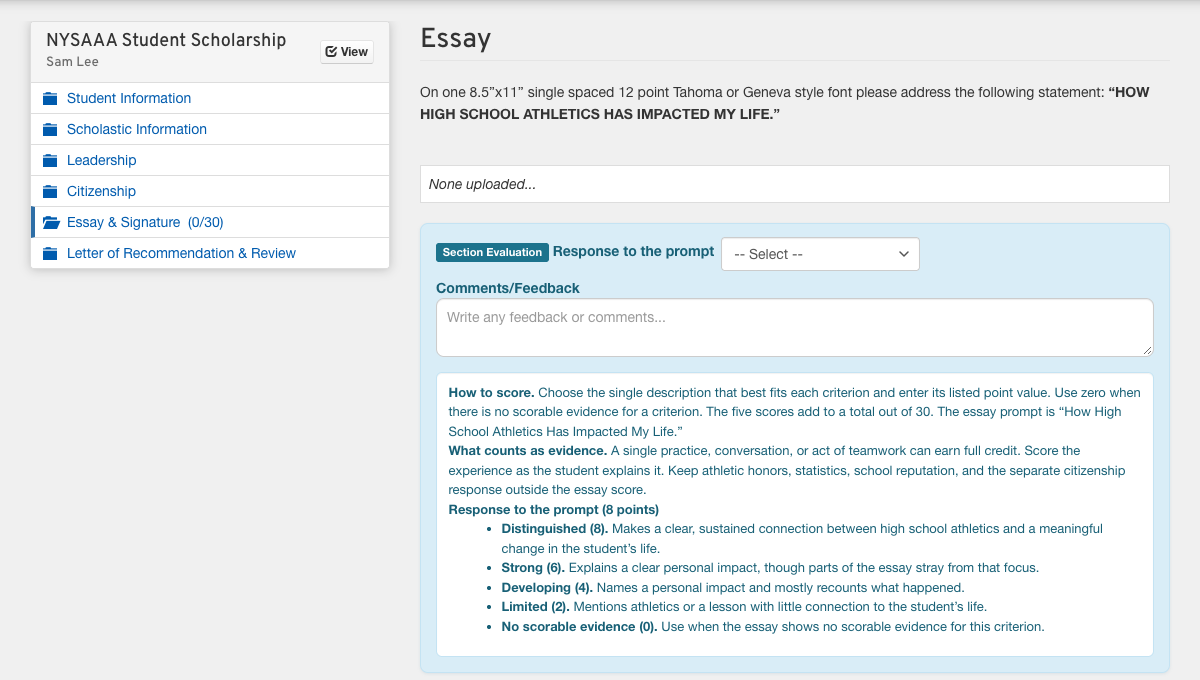
For each criterion, choose the one level that best describes the essay. The guide under the first criterion explains how to score and what counts as evidence.
- Response to the prompt and Depth of reflection: up to 8 points each.
- Specific examples: up to 6 points.
- Organization and focus and Voice and clarity: up to 4 points each.
- Choose No scorable evidence (0) when the essay shows nothing for that criterion.
- Add comments for the committee in the box under each score if you want to.
Save your scores and check the totals
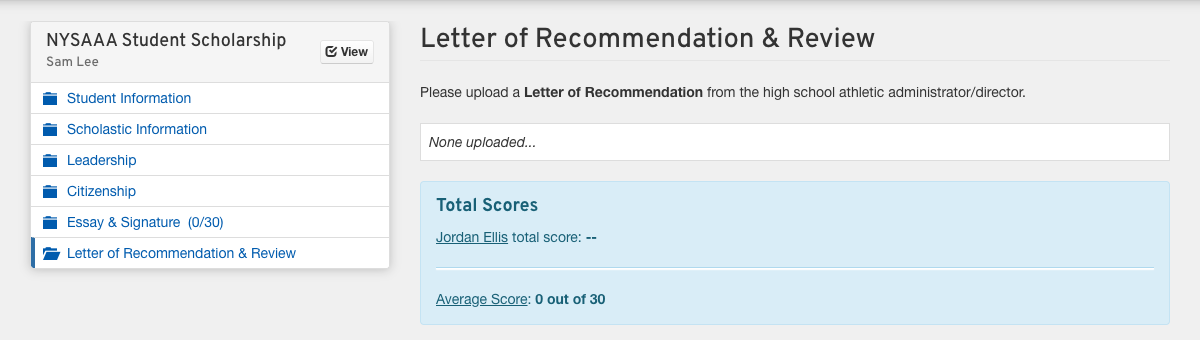
Click Save & Continue. The last page, Letter of Recommendation & Review, shows each judge’s total and the Average Score out of 30. The list on the left shows your running total next to Essay & Signature.
Good to know
- Score the experience as the student explains it. A single practice, conversation, or act of teamwork can earn full credit. Leave athletic honors, statistics, school reputation, and the separate citizenship response out of the essay score.
- Chapter winners are finalized by January 31, and the state committee evaluates in February. Submissions to the NIAAA section are due February 28.
- When two judges differ by 6 or more points, the committee gets an independent third score and averages all three. Tied averages are broken on the average Depth of reflection score, then the average Response to the prompt score; if still tied, the panel rereads the essays and records its reason. AMP shows the scores and averages but does not apply these rules for you.